How a brief becomes rules
What the reader understands, what it refuses to guess, and why the same sentence always gives the same agent.
When you type a brief into the builder, no language model reads it. A fixed reader does, and that choice is deliberate.
Why not a model
A model can turn almost any sentence into something that looks like a strategy. It can also turn the same sentence into two different strategies on two different days, and it will fill a gap with a guess that sounds reasonable. For something that will spend your money on a schedule, we want the opposite: the same words always give the same rules, and a gap stays visible.
What the reader looks for
- Markets. Tickers (NVDA, $TSLA), names (Tesla, gold, the S&P) and a few groups (chip stocks, meme stocks, the indexes).
- The kind of agent. Two or more “NN% of X” pairs make a basket. “Every Monday” or “every day” with an amount makes a scheduled buy. Anything else is read as buy and sell rules.
- Conditions. A move over a period (“drops 5% in a day”), a level (“below $150”), an average (“2% below its 48 hour average”), a recent high or low (“a new 3-day high”), and the RSI (“RSI below 30”, “oversold”).
- Exits. “Take profit 10%”, “stop loss 5%”, “hold at most 3 days”. In a sell sentence, “up 8%” with no period means 8% above your average entry.
- Money. A total budget, an amount per buy, and the most you want in one market.
What happens when it is unsure
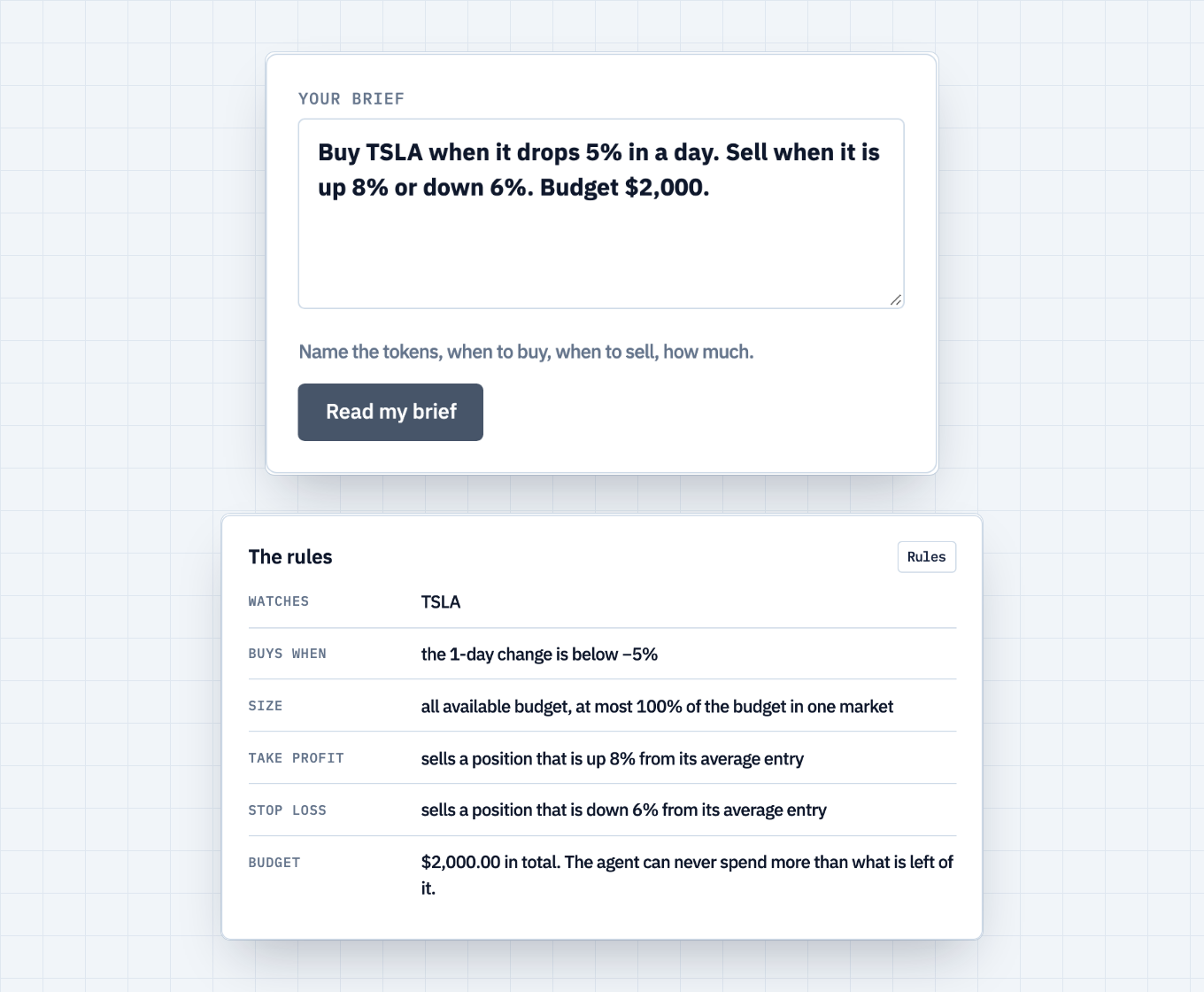
If there is no market in the brief, it stops and asks for one. If there is a market but no buying condition, it stops and shows three sentences that would work. If you say when to buy but not when to sell, it adds a 10% take profit and an 8% stop loss, and tells you, so the agent cannot end up holding forever by accident.
Periods are snapped to the windows the engine keeps: 1, 6, 12, 24, 48 and 72 hours, and 7 days. “Over two days” becomes 48 hours and the draft says “2-day”.
Then you read it back
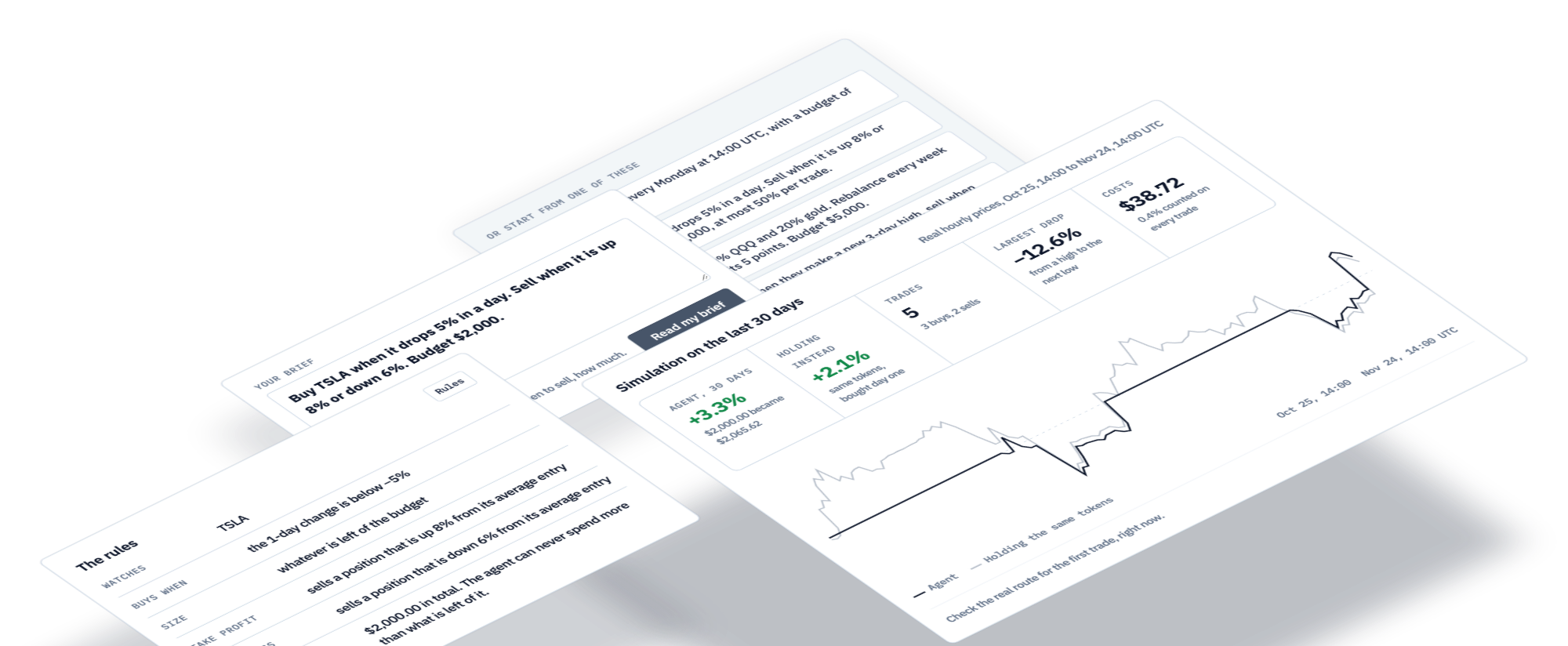
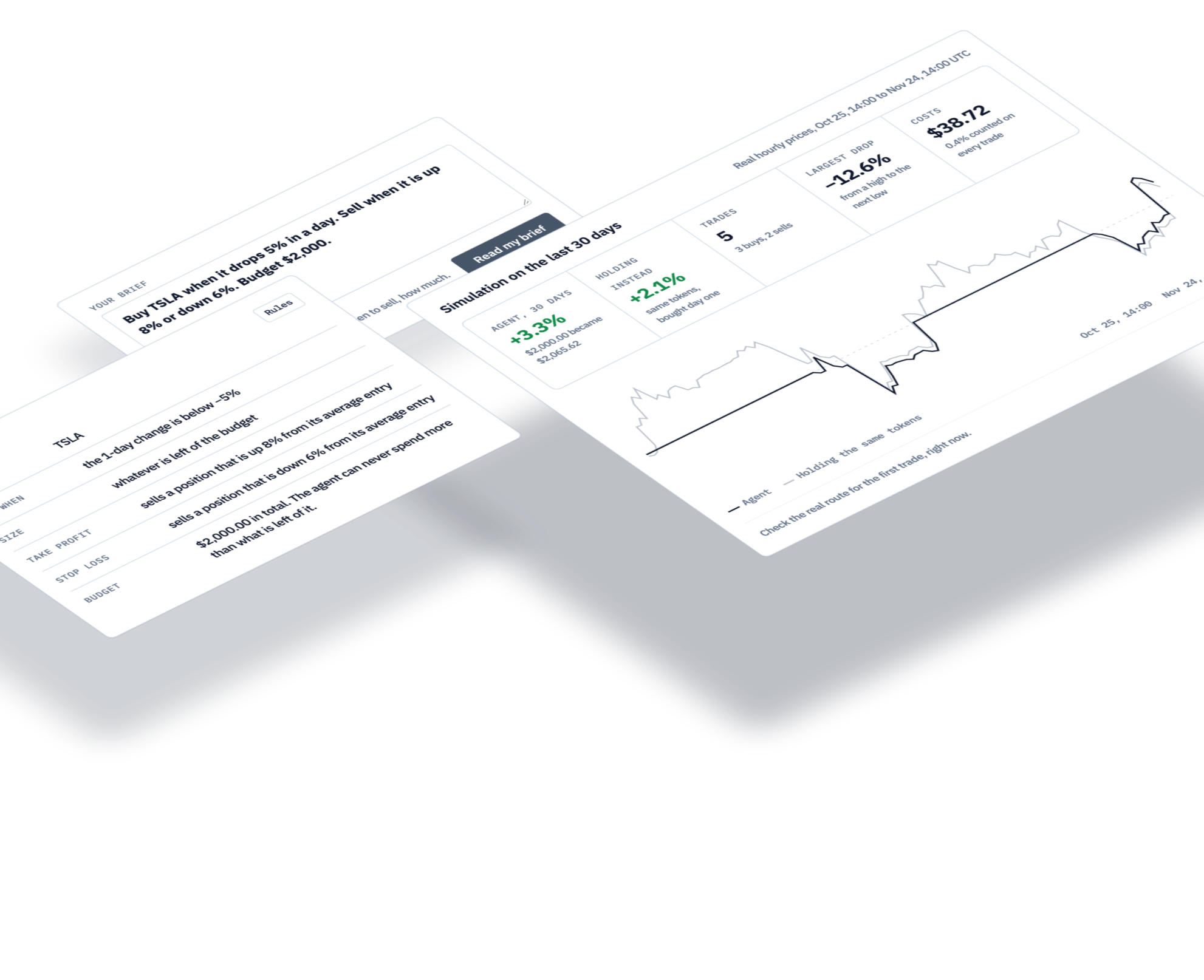
The draft is the contract. It lists what the agent watches, when it buys, when it sells, how much per trade and the total budget. If one line is not what you meant, change the number in the form or rewrite the sentence. The simulation updates each time.
A good test: read the rules out loud to someone else. If they can tell you what the agent will do on a bad day, it is ready for paper mode.
Write your first agent
One sentence is enough. You will see the rules and 30 days of simulation before anything runs.